Dissection of a featherie golf ball

(This article examines the construction and ingredients used to make a contemporary/replica featherie golf ball. This ball was not made in the exact same way that balls of the 1700s and 1800s were, although there are similarities. For more information on other contemporary featherie ball replicas, please see Contemporary Featherie Ball-makers.)

In the early 2000s and perhaps the mid- to late-1990s, the Featherie Golfe Company Ltd. of Toronto, Ontario, Canada, sold feather balls that were made in Guadalajara, Mexico, and distributed through a few vendors in Europe (and perhaps other areas as well, but we were unable to confirm this). The balls are marked with the script word Featherie and packaged in a small, printed cardboard box.
This confusing provenance has led to a variety of names for this modern feather ball: some call it the Canadian ball, some call it the Guadalajara ball or the Mexico ball, and still others refer to it as the British ball. The ball’s box shares some details, but no dates. Research has shown that the St. Andrews Golf Company in Scotland was selling these balls as early as the 1990s. Canadian government records show that the company was dissolved on February 5, 2007, but had not been active since October 28, 2006.
These balls do pop up for sale even after 30+ years, and they are hard, durable, and very playable. The Practical Clubmaker, Elmer Nahum, burst one of these balls on an indoor simulator, and he offered it to us for dissection. Our observations follow.
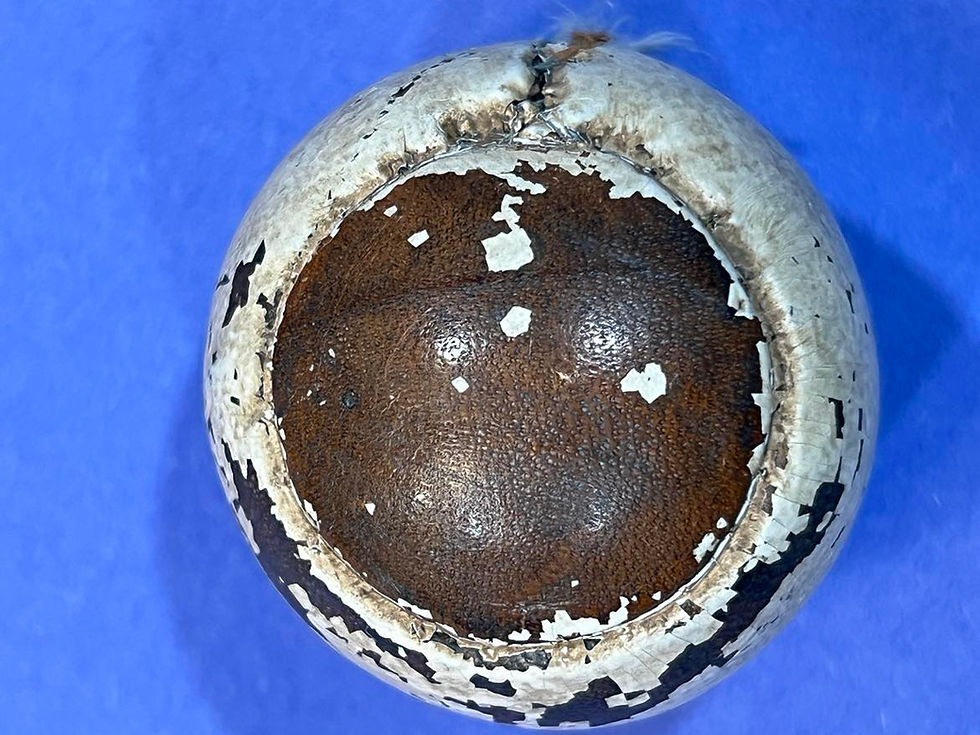
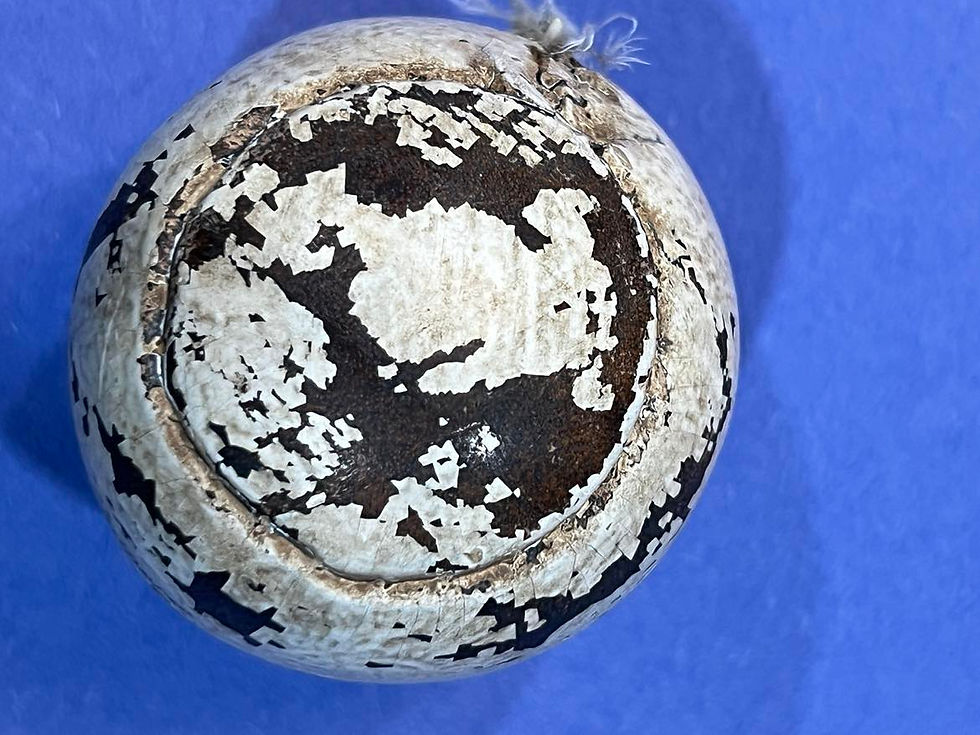


• Circumference (not perfectly round)
—1 23/32-inches around band at widest point
—1 43/64-inches around caps at widest point
• Original weight: 1.3 oz/35g (original featheries were usually between 1.5 oz and 1.7 oz).
• Weight of feathers: .9 oz./25g (note that the feathers are heavier than the leather; weight below)
• Variety of feathers: Unremarkable; likely mix of chicken/duck/goose. Mix of whole small feathers and down. Feathers do not appear to be chopped up. Some of the feathers at the far side from the stuffing hole have been compressed into hard clumps.
• Weight of leather (three dissected pieces): .4 oz/10g

• Size of caps: 1 1/2 inches round
• Size of strip: 4 3/4 x 1 5/8-inches

• Thread: 2-ply cotton or other natural fiber thread, confirmed by burn test. We suspect that the thread is waxed as it is somewhat stiff, although this could be due to exposure to the tanned leather or paint or age. But tweezer tips that held the string during the burn test were tacky, as if there was melted wax on them.
• Number of stitches around caps: 22, plus two to tie into strip on each side
• Number of stitches across belly: 6 (includes two tie-in stitches mentioned above)


• Sewing: Likely overhand-stitched with doubled two-ply thread, as evidenced by folded-in edges. This seems to be the process:
1. Cap 1 is sewed on to the strip (flesh-side out for both pieces) using backstitching, with one last stitch at finish to tie into the stuffing gap. The remaining long string is left for use later.
2. The second cap is sewn to the strip using the same process. Ball is still open across the belly.
3. Ball is turned inside out and then stuffed.
4. Working from either side, use a needle to thread one of the long leftover thread ends though the ball and stuffed feathers to emerge next to the other leftover string. Tie off this string. (See photo below.)
5. Both threads are laced onto the needle. Close the stuffing gap with an overhand stitch, then tie off both strings.

• Leather: This is very likely veg-tanned cow hide. Skin side is dark brown, and the flesh side is a lighter brown. The nap (the fuzziness on the flesh side of the leather) has been removed. Pieces are not skived on edges. Thickness is probably 3/64th- to 1/16th-inches thick. (In leather measurement, this equals a 3- to 4-oz leather.)


• Odor: Leather soaked in water has a woody, astringent smell. We theorize that it is veg-tanned with Querbraco bark. (Querbraco trees grow in a region between northern Argentina, Paraguay and Brazil, so the bark would be available to the Guadalahara. Another option is that the leather was tanned in South America and then shipped to Mexico.) The soaking-water had a reddish-brown tint when the leather was removed.

• Marks on flesh side: In some spots along the edges of the caps and strip, there appears to be ink dots that mark where holes should be punched. The lack of spots in other places could be attributed to the ink not being waterproof.
• Marks on the skin side: script Featherie, stamped with ink.
• Paint: Not white; more of a beige. Thin, probably one coat; grain shows through. Chips off easily; cracked from striking (?). Paint chips do not dissolve, soften, or return to solution when soaked in water for several days.
• Hole punches: Evenly spaced, about 1/8th-inch apart. Maybe all-in-one punch/stamp or hand-punched following rubber-stamped pattern? This company made a lot of balls, so it stands to reason that there would have been some automation.

Note: We have retained all part of this dissected ball, so please contact us if you have any other questions.


Comments